
Rogue Wave Views 5.5.1
Rogue Wave Views
Foundation Package API Reference Guide
Rogue Wave Views
Documentation Home
Rogue Wave Views 5.5.1 |
Rogue Wave Views |
Rogue Wave Views Documentation Home |
Convolution filter. More...
#include <ilviews/bitmaps/filters/convolve.h>
Public Member Functions | |
| IlvConvolutionFilter (IlvBitmapDataKernel *kernel=0, IlFloat divisor=0, IlFloat bias=0.0) | |
| Constructor. | |
| ~IlvConvolutionFilter () | |
| Destructor. | |
| IlvBitmapData * | apply (IlUInt count=0, const IlvBitmapData **inputs=0) |
| Applies the convolution to the given image. | |
| IlFloat | getBias () const |
| Returns the bias. | |
| IlFloat | getDivisor () const |
| Returns the divisor. | |
| IlvConvolutionFilter::EdgeMode | getEdgeMode () const |
| Returns the edge mode. | |
| IlvBitmapDataKernel * | getKernel () const |
| Returns the kernel. | |
| void | setBias (IlFloat bias) |
| Sets the bias. | |
| void | setDivisor (IlFloat divisor) |
| Sets the divisor. | |
| void | setEdgeMode (IlvConvolutionFilter::EdgeMode mode) |
| Sets the edge mode. | |
| void | setKernel (IlvBitmapDataKernel *kernel) |
| Sets the kernel. | |
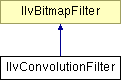
Convolution filter.
Library: ilvbmpflt
This bitmap filter lets you apply a matrix convolution to an image. A convolution combines pixels in the input image with neighboring pixels to produce a resulting image. A wide variety of imaging operations can be achieved through convolutions, including blurring, edge detection, sharpening, embossing, and beveling. A matrix convolution is based on an n-by-m matrix (the convolution kernel) that describes how a given pixel value in the input image is combined width its neighboring pixel values to produce a resulting pixel value.
To illustrate, suppose you have an input image that is 5 by 5 pixels, whose color values are as follows:
   0   20   40  235  235
 100  120  140  235  235
 200  220  240  235  255
 225  225  255  255  255
 225  225  255  255  255
and you define a 3-by-3 convolution kernel as follows:
  1  2  3
  4  5  6
  7  8  9
Let's focus on the pixel at the second row and second column of the source image (source pixel value is 120). The resulting pixel value will be:
 (1 * 0 + 2 * 20 + 3 * 40 +
 4 * 100 + 5 * 120 + 6 * 140 +
 7 * 200 + 8 * 220 + 9 * 240) / (1 + 2 + 3 +4 + 5 + 6 + 7 + 8 + 9)
By default the divisor is the sum of the kernel coefficients but can be specified. A bias value can be added after computing the value. An edge mode can be specified for border values. The edge mode can be one of:
IlvConvolutionFilter::Duplicate: The border pixels are duplicated. IlvConvolutionFilter::Wrap: The border pixels are extended using the opposite edge. IlvConvolutionFilter::None: The border pixels are extended with 0 values. IlvRGBBitmapData, IlvBitmapFilter, IlvBitmapKernel | IlvConvolutionFilter::IlvConvolutionFilter | ( | IlvBitmapDataKernel * | kernel = 0, |
|
| IlFloat | divisor = 0, |
|||
| IlFloat | bias = 0.0 | |||
| ) |
Constructor.
Initializes a new instance of the class IlvConvolutionFilter. The default operator is a 3x3 identity kernel.
| IlvConvolutionFilter::~IlvConvolutionFilter | ( | ) |
Destructor.
The destructor releases all the memory used by the instance.
| IlFloat IlvConvolutionFilter::getBias | ( | ) | const |
Returns the bias.
| IlFloat IlvConvolutionFilter::getDivisor | ( | ) | const |
Returns the divisor.
| IlvConvolutionFilter::EdgeMode IlvConvolutionFilter::getEdgeMode | ( | ) | const |
Returns the edge mode.
| IlvBitmapDataKernel* IlvConvolutionFilter::getKernel | ( | ) | const |
Returns the kernel.
| void IlvConvolutionFilter::setBias | ( | IlFloat | bias | ) |
Sets the bias.
| bias | The new bias. |
| void IlvConvolutionFilter::setDivisor | ( | IlFloat | divisor | ) |
Sets the divisor.
If the divisor is 0 then the sum of the kernel coefficients is used. If this coefficient is 0 then the divisor is 1.0.
| divisor | The new divisor. |
| void IlvConvolutionFilter::setEdgeMode | ( | IlvConvolutionFilter::EdgeMode | mode | ) |
Sets the edge mode.
| mode | The new edge mode. |
| void IlvConvolutionFilter::setKernel | ( | IlvBitmapDataKernel * | kernel | ) |
Sets the kernel.
| kernel | The new kernel. |
© Copyright 2012, Rogue Wave Software, Inc. All Rights Reserved.
Rogue Wave is a registered trademark of Rogue Wave Software, Inc. in the United States and other countries. All other trademarks are the property of their respective owners.