 |
Views Foundation Package API Reference Guide |
Views Documentation Home |
Resource class. More...
#include <ilviews/base/resource.h>

Public Member Functions | |
| IlUShort | getCount () const |
| Returns the length of the dash array. More... | |
| unsigned char * | getDashes () const |
| Returns the dash array. More... | |
| IlUShort | getOffset () const |
| Returns the dash offset. More... | |
| bool | scaleByLineWidth () const |
| Returns true if dash and gap lengths are scaled by line width. More... | |
 Public Member Functions inherited from IlvResource Public Member Functions inherited from IlvResource | |
| IlvDisplay * | getDisplay () const |
Gets the IlvDisplay instance. More... | |
| const char * | getName () const |
| Gets the resource name. More... | |
| void | lock () |
| Locks the resource. More... | |
| virtual void | setName (const char *name) |
| Sets the name of the resource. More... | |
| virtual void | unLock () |
| Unlocks the resource. More... | |
Friends | |
| class | IlvDisplay |
Resource class.
Library: xviews or winviews or mviews (mutually exclusive)
The class IlvLineStyle represents the line style resources. A line style is an array of unsigned characters returned by the member function getDashes(). The length of the array is returned by the getCount() member function. Other line styles are predefined and may be accessed through the naming mechanism:
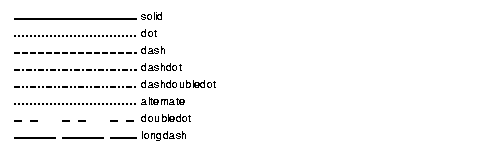
- IlvLineStyle -
Although this class does not have any public constructor, you may define your own line styles by means of calls to the member function IlvDisplay::getLineStyle(). You can name these new line styles to access them by name.
| IlUShort IlvLineStyle::getCount | ( | ) | const |
Returns the length of the dash array.
| unsigned char* IlvLineStyle::getDashes | ( | ) | const |
Returns the dash array.
When a line is drawn using this line style, the number of foreground-colored pixels is indicated by the elements of the returned array. This array must not be modified or deleted.
| IlUShort IlvLineStyle::getOffset | ( | ) | const |
Returns the dash offset.
| bool IlvLineStyle::scaleByLineWidth | ( | ) | const |
Returns true if dash and gap lengths are scaled by line width.
When true (default), both dashes and gaps in the pattern are multiplied by the line width during rendering. When false, the dash and gap values represent exact pixel lengths regardless of line width, providing precise control over the pattern size.
|
Copyright 2021 Rogue Wave Software, Inc., a Perforce company. All Rights Reserved. |

|