Using Internet Addresses
Internet addresses are the most popular socket address family. They identify communication endpoints on an internet, which is a network of computers that communicate using the TCP/IP suite of protocols. The “capital-I” Internet is the best known internet, but the Internet family of addresses is also used for thousands of smaller networks.
An internet address has two parts:
• Host, which identifies the computer
• Port, which identifies where to send information to the host
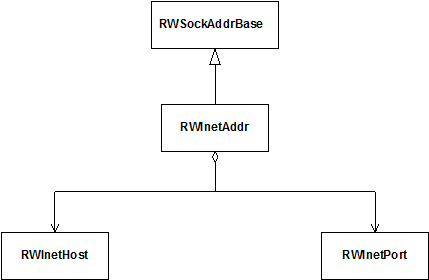
An internet address is represented in the Networking package as an
RWInetAddr. As shown in
Figure 10 , an
RWInetAddr object contains two objects: an
RWInetHost to represent the host, and an
RWInetPort to represent the port.
Constructing a Host
A host is identified by either a symbolic name, like net.roguewave.com, or by an Internet Protocol (IP) address, like 198.68.9.6. A particular host can have more than one symbolic name. A host address usually has only one IP address, although it is possible for a host to have more than one address.
You can construct a host object by specifying either the IP address or host name as a string, as shown in the following examples.
RWInetHost host1("net.roguewave.com");
RWInetHost host2("198.68.9.6");
Once a host object is constructed, you can use the member functions of
RWInetHost to determine characteristics of the host.
Example 9 prints information about a host.
Example 9 – Printing information about a host
#include <rw/rstream.h>
#include <rw/network/RWInetAddr.h>
int main()
{
RWWinSockInfo info;
RWInetHost host = RWInetHost::me(); //1
cout << host.getName() << endl; //2
cout << RWInetHost::addressAsString(host.getAddress())
<< endl; //3
return 0;
}
Building Internet Addresses
Example 10 shows how to build an Internet address object by specifying the port and then the host.
Example 10 – Building internet addresses
RWInetAddr addr1( 3010, "net.roguewave.com" ); //1
RWInetAddr addr2( 3010 ); //2
RWInetAddr addr3( "stream:net.roguewave.com:3010" ); //3