 HydraExpress™ C++ 2025.2.2 |
HydraExpress™ C++ API Reference Guide |
Loading...
Searching...
No Matches
HydraExpress™ C++ 2025.2.2 |
HydraExpress™ C++ API Reference Guide |
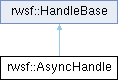
Represents an asynchronous operation in the generated proxy classes. More...
#include <rwsf/webservice/AsyncHandle.h>
Public Member Functions | |
| AsyncHandle () | |
| AsyncHandle (const AsyncHandle &handle) | |
| ~AsyncHandle () | |
| virtual rwsf::CallInfo | getCallInfo () const |
| virtual void | join () |
| AsyncHandle & | operator= (const AsyncHandle &obj) |
| Public Member Functions inherited from rwsf::HandleBase | |
| bool | isValid (void) const |
| bool | operator!= (const HandleBase &second) const |
| bool | operator== (const HandleBase &second) const |
Additional Inherited Members | |
| Protected Member Functions inherited from rwsf::HandleBase | |
| HandleBase (BodyBase *body) | |
| HandleBase (const HandleBase &second) | |
| HandleBase (StaticCtor) | |
| HandleBase (void) | |
| virtual | ~HandleBase (void) |
| BodyBase & | body (void) const |
| HandleBase & | operator= (const HandleBase &second) |
rwsf::AsyncHandle is used to represent an asynchronous operation. An instance of this class is a reference returned by an asynchronous Start() method and required for an asynchronous End() method.
Generated proxies include both synchronous and asynchronous versions of each service operation method. Depending on the needs of your client, use either the synchronous method or the asynchronous method.
For example, following is an excerpt of the generated service operation methods for the example DayofWeek, reformatted slightly to make it more readable:
For information on asynchronous processing, see the Web Service Development Guide.
| rwsf::AsyncHandle::AsyncHandle | ( | ) |
Default constructor. Constructs an empty handle.
| rwsf::AsyncHandle::AsyncHandle | ( | const AsyncHandle & | handle | ) |
Copy constructor. Creates a new handle and increments a reference count.
| rwsf::AsyncHandle::~AsyncHandle | ( | ) |
Destructor. Detaches from the current body (if any), decrements its reference count, and deletes it and its thread if there are no other references.
|
virtual |
Returns a copy of the rwsf::CallInfo object instance associated with the asynchronous operation. When the operation has completed, this object will hold properties of the response message (such as transport and SOAP headers).
|
virtual |
Joins the thread. Throws an rwsf::Exception "Invalid Async Handler" if the thread cannot be found. Use this method to complete an asynchronous operation without having to call the specific [operation]End() method. This is useful if there is no data to retrieve, or you don't care about returned data.
| AsyncHandle & rwsf::AsyncHandle::operator= | ( | const AsyncHandle & | obj | ) |
Assignment operator.
|
Copyright © 2026 Rogue Wave Software, Inc., a Perforce company. All Rights Reserved. |