
Abstract base class managing a calendar date. More...
#include <ilog/calendar.h>
Public Types |
|
| enum | EAmpm { AM, PM } |
| Constants for the hour in a 12-hour clock. More... |
|
| enum | EDaysOfWeek { SUNDAY, MONDAY, TUESDAY, WEDNESDAY, THURSDAY, FRIDAY, SATURDAY } |
| Constants for days of the week. More... |
|
| enum | EMonths { JANUARY, FEBRUARY, MARCH, APRIL, MAY, JUNE, JULY, AUGUST, SEPTEMBER, OCTOBER, NOVEMBER, DECEMBER, UNDECIMBER } |
| Constants for the month. More... |
|
| enum | IlDateFields { ERA, YEAR, MONTH, WEEK_OF_YEAR, WEEK_OF_MONTH, DATE, DAY_OF_YEAR, DAY_OF_WEEK, DAY_OF_WEEK_IN_MONTH, AM_PM, HOUR, HOUR_OF_DAY, MINUTE, SECOND, MILLISECOND, ZONE_OFFSET, DST_OFFSET } |
| Field IDs for date and time. More... |
|
Public Member Functions |
|
| virtual | ~IlCalendar () |
| Destructor. |
|
| virtual void | add (IlDateFields field, IlInt amount, IlDateErrorCode &status)=0 |
An arithmetic function for IlDate type. This function adds the specified (signed) amount of time to the given time field, based on the calendar rules. More... |
|
| void | adoptTimeZone (IlTimeZone *value) |
| Sets the calendar time zone to be the one passed in. More... |
|
| IlBoolean | after (const IlCalendar &when, IlDateErrorCode &status) const |
Returns IlTrue if this IlCalendar current time is after when current time. More... |
|
| IlBoolean | before (const IlCalendar &when, IlDateErrorCode &status) const |
Returns IlTrue if this IlCalendar current time is before when current time. More... |
|
| void | clear () |
| Clears the values of all the time fields, making them both unset and assigning them a value of zero. More... |
|
| void | clear (IlDateFields field) |
| Clears the value in the given time field, both making it unset and assigning it a value of zero. More... |
|
| virtual IlCalendar * | clone () const =0 |
| Creates and returns a polymorphic copy of this calendar. |
|
| IlBoolean | equals (const IlCalendar &when, IlDateErrorCode &status) const |
Compares the IlCalendar time, whereas IlCalendar::operator== compares the equality of IlCalendar objects. More... |
|
| virtual IlBoolean | equivalentTo (const IlCalendar &other) const |
Returns IlTrue if another IlCalendar object is equivalent to this one. More... |
|
| virtual IlInt | fieldDifference (IlDate when, IlDateFields field, IlDateErrorCode &status) |
| Returns the difference between the given time and the time this calendar object is set to. More... |
|
| IlInt | get (IlDateFields field, IlDateErrorCode &status) const |
| Indicates the value for a given time field. More... |
|
| IlInt | getActualMaximum (IlDateFields field, IlDateErrorCode &status) const |
| Returns the maximum value that this field could have, given the current date. More... |
|
| IlInt | getActualMinimum (IlDateFields field, IlDateErrorCode &status) const |
| Returns the minimum value that this field could have, given the current date. More... |
|
| EDaysOfWeek | getFirstDayOfWeek () const |
| Returns the first day of the week; for example, Sunday in US, Monday in France. More... |
|
| virtual IlInt | getGreatestMinimum (IlDateFields field) const =0 |
| Indicates the highest minimum value for the given field if it varies. More... |
|
| virtual IlInt | getLeastMaximum (IlDateFields field) const =0 |
| Indicates the lowest maximum value for the given field if it varies. More... |
|
| virtual IlInt | getMaximum (IlDateFields field) const =0 |
| Indicates the maximum value for the given time field. More... |
|
| IlUChar | getMinimalDaysInFirstWeek () const |
| Indicates the minimal days required in the first week of the year. More... |
|
| virtual IlInt | getMinimum (IlDateFields field) const =0 |
| Indicates the minimum value for the given time field. More... |
|
| IlDate | getTime (IlDateErrorCode &status) const |
Gets this IlCalendar time as milliseconds. More... |
|
| const IlTimeZone & | getTimeZone () const |
| Returns a reference to the time zone owned by this calendar. More... |
|
| virtual IlBoolean | inDaylightTime (IlDateErrorCode &status) const =0 |
Queries if the current date for this IlCalendar is in Daylight Savings Time. More... |
|
| IlBoolean | isLenient () const |
| Indicates whether the date/time interpretation is lenient. More... |
|
| IlBoolean | isSet (IlDateFields field) const |
| Determines if the given time field has a value set. More... |
|
| IlBoolean | operator!= (const IlCalendar &that) const |
Compares the inequality of two IlCalendar objects. More... |
|
| virtual IlBoolean | operator== (const IlCalendar &that) const |
Compares the equality of two IlCalendar objects. More... |
|
| IlTimeZone * | orphanTimeZone () |
| Returns the time zone owned by this calendar. More... |
|
| void | roll (IlDateFields field, IlBoolean up, IlDateErrorCode &status) |
| Time Field Rolling function: rolls (up/down) a single unit of time on the given time field. More... |
|
| virtual void | roll (IlDateFields field, IlInt amount, IlDateErrorCode &status)=0 |
| Time Field Rolling function: rolls the given amount on the given time field. More... |
|
| IlDate | set (const char *date, IlDateErrorCode &status) |
| Sets the date from the provided ISO 8601 string. More... |
|
| void | set (IlDateFields field, IlInt value) |
| Sets the given time field with the given value. More... |
|
| void | set (IlInt year, IlInt month, IlInt date) |
Sets the values for the fields YEAR, MONTH, and DATE. More... |
|
| void | set (IlInt year, IlInt month, IlInt date, IlInt hour, IlInt minute) |
Sets the values for the fields YEAR, MONTH, DATE, HOUR_OF_DAY, and MINUTE. More... |
|
| void | set (IlInt year, IlInt month, IlInt date, IlInt hour, IlInt minute, IlInt second) |
Sets the values for the fields YEAR, MONTH, DATE, HOUR_OF_DAY, MINUTE, and SECOND. More... |
|
| void | setFirstDayOfWeek (EDaysOfWeek value) |
| Sets the first day of the week; for example, Sunday in US, Monday in France. More... |
|
| void | setLenient (IlBoolean lenient) |
| Specifies whether or not the date/time interpretation is to be lenient. More... |
|
| void | setMinimalDaysInFirstWeek (IlUChar value) |
| Sets the minimal days required in the first week of the year. More... |
|
| void | setTime (IlDate date, IlDateErrorCode &status) |
Sets this IlCalendar current time with the given IlDate. More... |
|
| void | setTimeZone (const IlTimeZone &zone) |
| Sets the calendar time zone to be the same as the one passed in. More... |
|
Static Public Member Functions |
|
| static IlCalendar * | createInstance (const IlLocale &aLocale, IlDateErrorCode &success) |
Creates an IlCalendar using the default time zone and the given locale. More... |
|
| static IlCalendar * | createInstance (const IlTimeZone &zone, IlDateErrorCode &success) |
Creates an IlCalendar using the given time zone and the default locale. More... |
|
| static IlCalendar * | createInstance (const IlTimeZone &zoneToAdopt, const IlLocale &aLocale, IlDateErrorCode &success) |
Gets an IlCalendar using the given time zone and given locale. More... |
|
| static IlCalendar * | createInstance (IlDateErrorCode &success) |
Creates an IlCalendar that uses the default time zone and locale. More... |
|
| static IlCalendar * | createInstance (IlTimeZone *zoneToAdopt, const IlLocale &aLocale, IlDateErrorCode &success) |
Creates an IlCalendar using the given time zone and locale. More... |
|
| static IlCalendar * | createInstance (IlTimeZone *zoneToAdopt, IlDateErrorCode &success) |
Creates an IlCalendar using the given time zone and the default locale. More... |
|
| static IlDate | getNow () |
Returns the current UTC (GMT) time measured in milliseconds since 0:00:00 on 1/1/70 (derived from the system time). More... |
|
Protected Member Functions |
|
| IlCalendar (const IlCalendar &source) | |
| Copy constructor. More... |
|
| IlCalendar (const IlTimeZone &zone, const IlLocale &locale, IlDateErrorCode &success) | |
Initializes a new IlCalendar with the given time zone and locale. More... |
|
| IlCalendar (IlDateErrorCode &success) | |
Constructs an IlCalendar with the default time zone and locale. More... |
|
| IlCalendar (IlTimeZone *zone, const IlLocale &locale, IlDateErrorCode &success) | |
Initializes a new IlCalendar with the given time zone and locale. More... |
|
| void | complete (IlDateErrorCode &status) |
| Recomputes the current time from currently set fields. More... |
|
| virtual void | computeFields (IlDateErrorCode &status)=0 |
| Converts GMT as milliseconds to time field values. More... |
|
| virtual void | computeTime (IlDateErrorCode &status)=0 |
Converts IlCalendar time field values to GMT, in milliseconds. More... |
|
| double | getTimeInMillis (IlDateErrorCode &status) const |
Gets this IlCalendar current time as a long. More... |
|
| IlInt | internalGet (IlDateFields field) const |
| Gets the value for a given time field. More... |
|
| IlDate | internalGetTime () const |
| Gets the current time without recomputing. |
|
| void | internalSet (IlDateFields field, IlInt value) |
| Sets the value for a given time field. More... |
|
| void | internalSetTime (IlDate time) |
| Sets the current time without affecting flags or fields. |
|
| IlCalendar & | operator= (const IlCalendar &right) |
| The default assignment operator. |
|
| void | setTimeInMillis (double millis, IlDateErrorCode &status) |
Sets this IlCalendar current time from the given long value. More... |
|
Protected Attributes |
|
| IlBoolean | fAreAllFieldsSet |
| Indicates if all of the fields have been set. More... |
|
| IlBoolean | fAreFieldsSet |
| IlInt | fFields [FIELD_COUNT] |
| IlBoolean | fIsSet [FIELD_COUNT] |
| IlBoolean | fIsTimeSet |
| IlInt | fStamp [FIELD_COUNT] |
| Pseudo-time-stamps that specify when each field was set. More... |
|
Detailed Description
Abstract base class managing a calendar date.
Library: ilog
From IBM ICU classes, adapted for Rogue Wave Views libraries.
Copyright (C) 1997-1999, International Business Machines Corporation and others. All Rights Reserved.
IlCalendar is an abstract base class for converting between a IlDate object and a set of integer fields such as YEAR, MONTH, DAY, HOUR, and so on. (A IlDate object represents a specific instant in time with millisecond precision.)
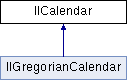
Subclasses of IlCalendar interpret a IlDate according to the rules of a specific calendar system. The Rogue Wave Views library provides one concrete subclass of IlCalendar: IlGregorianCalendar. Future subclasses could represent the various types of lunar calendars in use in many parts of the world.
Like other locale-sensitive classes, IlCalendar provides a class method, getInstance, for getting a generally useful object of this type. IlCalendar getInstance() method returns a IlGregorianCalendar object whose time fields have been initialized with the current date and time:
An IlCalendar object can produce all the time field values needed to implement the date-time formatting for a particular language and calendar style (for example, Japanese-Gregorian, Japanese-Traditional).
When computing a IlDate from time fields, two special circumstances may arise: there may be insufficient information to compute the IlDate (such as only year and month but no day in the month), or there may be inconsistent information (such as "Tuesday, July 15, 1996" – July 15, 1996 is actually a Monday).
Insufficient information. The calendar will use default information to specify the missing fields. This may vary by calendar; for the Gregorian calendar, the default for a field is the same as that of the start of the epoch: that is, YEAR = 1970, MONTH = JANUARY, DATE = 1, and so on.
Inconsistent information. If fields conflict, the calendar will give preference to fields set more recently. For example, when determining the day, the calendar will look for one of the following combinations of fields. The most recent combination, as determined by the most recently set single field, will be used.
For the time of day:
Note: for some non-Gregorian calendars, different fields may be necessary for complete disambiguation. For example, a full specification of the historical Arabic astronomical calendar requires year, month, day-of-month and day-of-week in some cases.
- Note
- There are possible ambiguities in the interpretation of certain singular times, which are resolved in the following ways:
24:00:00belongs to the following day. That is,23:59onDec 31, 1969 < 24:00onJan 1, 1970 < 24:01:00onJan 1, 1970-
Although historically not precise, midnight also belongs to
am, and noon belongs topm, so on the same day,12:00 am(midnight)< 12:01 am, and12:00 pm(noon)< 12:01 pm
The date or time format strings are not part of the definition of a calendar, as those can be modified or overriden by the user at runtime.
IlCalendar provides an API for field rolling, where fields can be incremented or decremented, but wrap around. For example, rolling the month up in the date December 12, 1996 results in January 12, 1996.
IlCalendar also provides a date arithmetic function for adding the specified (signed) amount of time to a particular time field. For example, subtracting 5 days from the date September 12, 1996 results in September 7, 1996.
Member Enumeration Documentation
◆ EAmpm
| enum IlCalendar::EAmpm |
Constants for the hour in a 12-hour clock.
Used in IlGregorianCalendar.
| Enumerator | |
|---|---|
| AM |
Ante meridiem; designates the time from midnight to noon. |
| PM |
Post meridiem; designates the time from noon to midnight. |
◆ EDaysOfWeek
Constants for days of the week.
Note: The IlCalendar day-of-week is 1-based.
Users who create locale resources for the field fFirstDayOfWeek should be aware of this. For instance, in the US locale, fFirstDayOfWeek is set to 1, that is, SUNDAY.
◆ EMonths
| enum IlCalendar::EMonths |
Constants for the month.
Note: The IlCalendar month is 0-based.
◆ IlDateFields
Field IDs for date and time.
Used to specify date/time fields. The ERA is calendar specific. Example ranges given are for illustration only; see specific IlCalendar subclasses for actual ranges.
Constructor & Destructor Documentation
◆ IlCalendar() [1/4]
|
protected |
Constructs an IlCalendar with the default time zone and locale.
The time zone is the one returned by IlTimeZone::createInstance().
- Parameters
-
success Indicates the status of the IlCalendarobject construction: it is set toIL_DATE_ZERO_ERRORif the object is constructed successfully.
◆ IlCalendar() [2/4]
|
protected |
Copy constructor.
Copy constructor
◆ IlCalendar() [3/4]
|
protected |
Initializes a new IlCalendar with the given time zone and locale.
Clients are no longer responsible for deleting the given time zone object after it has been adopted.
- Parameters
-
zone The given time zone. locale The given locale. success Indicates the status of the IlCalendarobject construction. It is set toIL_DATE_ZERO_ERRORif initialized successfully.
◆ IlCalendar() [4/4]
|
protected |
Initializes a new IlCalendar with the given time zone and locale.
- Parameters
-
zone The given time zone. locale The given locale. success Indicates the status of the IlCalendarobject construction. It is set toIL_DATE_ZERO_ERRORif initialized successfully.
Member Function Documentation
◆ add()
|
pure virtual |
An arithmetic function for IlDate type. This function adds the specified (signed) amount of time to the given time field, based on the calendar rules.
For example, to subtract 5 days from the current time of the calendar, call add(IlCalendar::DATE, -5). When adding on the month or IlCalendar::MONTH field, other fields such as date might conflict and need to be changed. For instance, adding 1 month on the date 01/31/96 will result in 02/29/96.
- Parameters
-
field Specifies which date field to modify. amount The amount of time to be added to the field, in the natural unit for that field (for example, days for the day fields, hours for the hour field). status An output parameter set to a success/failure code on exit. If any value previously set in the time field is invalid or restricted by leniency, this will be set to an error status.
Implemented in IlGregorianCalendar.
◆ adoptTimeZone()
| void IlCalendar::adoptTimeZone | ( | IlTimeZone * | value | ) |
Sets the calendar time zone to be the one passed in.
The IlCalendar takes ownership of the IlTimeZone; the caller is no longer responsible for deleting it. If the given time zone is 0, this function has no effect.
- Parameters
-
value The given time zone.
◆ after()
| IlBoolean IlCalendar::after | ( | const IlCalendar & | when, |
| IlDateErrorCode & | status | ||
| ) | const |
Returns IlTrue if this IlCalendar current time is after when current time.
- Parameters
-
when The IlCalendarto be compared with thisIlCalendar. Although this is aconstparameter, the object may be modified physically.status An output parameter set to a success/failure code on exit. If any value previously set in the time field is invalid or restricted by leniency, this will be set to an error status.
- Returns
IlTrueif the current time of thisIlCalendaris after the time ofIlCalendarwhen;IlFalseotherwise.
◆ before()
| IlBoolean IlCalendar::before | ( | const IlCalendar & | when, |
| IlDateErrorCode & | status | ||
| ) | const |
Returns IlTrue if this IlCalendar current time is before when current time.
- Parameters
-
when The IlCalendarto be compared with thisIlCalendar. Although this is aconstparameter, the object may be modified physically.status Output param set to success/failure code on exit. If any value previously set in the time field is invalid or restricted by leniency, this will be set to an error status.
- Returns
IlTrueif the current time of thisIlCalendaris before the time ofIlCalendarwhen;IlFalseotherwise.
◆ clear() [1/2]
| void IlCalendar::clear | ( | ) |
Clears the values of all the time fields, making them both unset and assigning them a value of zero.
The field values will be determined during the next resolving of time into time fields.
◆ clear() [2/2]
| void IlCalendar::clear | ( | IlDateFields | field | ) |
Clears the value in the given time field, both making it unset and assigning it a value of zero.
This field value will be determined during the next resolving of time into time fields.
- Parameters
-
field The time field to be cleared.
◆ complete()
|
protected |
Recomputes the current time from currently set fields.
After computation, any unset fields in the time field list are set.
- Parameters
-
status An output parameter set to a success/failure code on exit. If any value previously set in the time field is invalid or restricted by leniency, this will be set to an error status.
◆ computeFields()
|
protectedpure virtual |
Converts GMT as milliseconds to time field values.
This allows you to sync up the time field values with a new time that is set for the calendar. This method does NOT recompute the time first; to recompute the time, then the fields, use the method complete().
- Parameters
-
status An output parameter set to a success/failure code on exit.
Implemented in IlGregorianCalendar.
◆ computeTime()
|
protectedpure virtual |
Converts IlCalendar time field values to GMT, in milliseconds.
- Parameters
-
status An output parameter set to a success/failure code on exit. If any value previously set in the time field is invalid or restricted by leniency, this will be set to an error status.
Implemented in IlGregorianCalendar.
◆ createInstance() [1/6]
|
static |
Creates an IlCalendar using the default time zone and the given locale.
- Parameters
-
aLocale The given locale. success Indicates the success/failure of IlCalendarcreation. Filled in withIL_ZERO_ERRORif created successfully, set to a failure result otherwise.
- Returns
- An
IlCalendarif created successfully,0otherwise.
◆ createInstance() [2/6]
|
static |
Creates an IlCalendar using the given time zone and the default locale.
The IlTimeZone is not adopted; it is the responsibility of the users to delete it.
- Parameters
-
zone The time zone. success Indicates the success/failure of IlCalendarcreation. Filled in withIL_ZERO_ERRORif created successfully, set to a failure result otherwise.
- Returns
- An
IlCalendarif created successfully,0otherwise.
◆ createInstance() [3/6]
|
static |
Gets an IlCalendar using the given time zone and given locale.
The IlTimeZone is not adopted; the client is still responsible for deleting it.
- Parameters
-
zoneToAdopt The time zone. aLocale The given locale. success Indicates the success/failure of IlCalendarcreation. Filled in withIL_DATE_ZERO_ERRORif created successfully, set to a failure result otherwise.
- Returns
- An
IlCalendarif created successfully,0otherwise.
◆ createInstance() [4/6]
|
static |
Creates an IlCalendar that uses the default time zone and locale.
Users are responsible for deleting the returned object.
- Parameters
-
success Indicates the success/failure of IlCalendarcreation. Filled in withIL_ZERO_ERRORif created successfully, set to a failure result otherwise.
- Returns
- An
IlCalendarif created successfully,0otherwise.
◆ createInstance() [5/6]
|
static |
Creates an IlCalendar using the given time zone and locale.
The IlCalendar takes ownership of zoneToAdopt; the client must not delete it.
- Parameters
-
zoneToAdopt The given time zone to be adopted. aLocale The given locale. success Indicates the success/failure of IlCalendarcreation. Filled in withIL_DATE_ZERO_ERRORif created successfully, set to a failure result otherwise.
- Returns
- An
IlCalendarif created successfully,0otherwise.
◆ createInstance() [6/6]
|
static |
Creates an IlCalendar using the given time zone and the default locale.
The IlCalendar takes ownership of zoneToAdopt; users should not delete it.
- Parameters
-
zoneToAdopt The given time zone to be adopted. success Indicates the success/failure of IlCalendarcreation. Filled in withIL_ZERO_ERRORif created successfully, set to a failure result otherwise.
- Returns
- An
IlCalendarif created successfully,0otherwise.
◆ equals()
| IlBoolean IlCalendar::equals | ( | const IlCalendar & | when, |
| IlDateErrorCode & | status | ||
| ) | const |
Compares the IlCalendar time, whereas IlCalendar::operator== compares the equality of IlCalendar objects.
- Parameters
-
when The IlCalendarto be compared with thisIlCalendar. Although this is aconstparameter, the object may be modified physically.status Output param set to success/failure code on exit. If any value previously set in the time field is invalid or restricted by leniency, this will be set to an error status.
- Returns
IlTrueif the current time of thisIlCalendaris equal to the time ofIlCalendarwhen;IlFalseotherwise.
◆ equivalentTo()
|
virtual |
Returns IlTrue if another IlCalendar object is equivalent to this one.
An equivalent IlCalendar will behave exactly as this one does, but may be set to a different time.
Reimplemented in IlGregorianCalendar.
◆ fieldDifference()
|
virtual |
Returns the difference between the given time and the time this calendar object is set to.
If this calendar is set before the given time, the returned value will be positive. If this calendar is set after the given time, the returned value will be negative. The field parameter specifies the units of the return value. For example, if fieldDifference(when, IlCalendar.MONTH) returns 3, then this calendar is set to 3 months before when, and possibly some additional time less than one month.
As a side effect of this call, this calendar is advanced toward when by the given amount. That is, calling this method has the side effect of calling add(field, n), where n is the return value.
Usage: To use this method, call it first with the largest field of interest, then with progressively smaller fields. For example:
computes the difference between cal and when in years, months, and days.
Note: fieldDifference() is asymmetrical. That is, in the following code:
you might expect that m1 == -m2 && d1 == -d2. However, this is not generally the case, because of irregularities in the underlying calendar system (for example, the Gregorian calendar has a variable number of days per month).
- Parameters
-
when The date to compare this calendar time to. field The field in which to compute the result. status An output parameter set to a success/failure code on exit. If any value previously set in the time field is invalid, this will be set to an error status.
- Returns
- The difference, either positive or negative, between this calendar time and when, in terms of field.
◆ get()
| IlInt IlCalendar::get | ( | IlDateFields | field, |
| IlDateErrorCode & | status | ||
| ) | const |
Indicates the value for a given time field.
It recalculates the current time field values if the time value has been changed by a call to setTime(). It returns 0 for unset fields if any fields have been explicitly set by a call to set(). To force a recomputation of all fields regardless of the previous state, call complete(). This method is semantically const, but may actually alter the object in memory.
- Parameters
-
field The given time field. status Fill-in parameter which receives the status of the operation.
- Returns
- The value for the given time field, or
0ifthe field is unset andset()has been called for any other field.
◆ getActualMaximum()
| IlInt IlCalendar::getActualMaximum | ( | IlDateFields | field, |
| IlDateErrorCode & | status | ||
| ) | const |
Returns the maximum value that this field could have, given the current date.
For example, with the date Feb 3, 1997 and the DAY_OF_MONTH field, the actual maximum would be 28; for Feb 3, 1996, it is 29.
Similarly, for a Hebrew calendar, for some years the actual maximum for MONTH is 12, and for others it is 13.
The version of this function on IlCalendar uses an iterative algorithm to determine the actual maximum value for the field. There is almost always a more efficient way to accomplish this (in most cases, you can simply return getMaximum()). IlGregorianCalendar overrides this function with a more efficient implementation.
- Parameters
-
field The given time field. status An output parameter set to a success/failure code on exit. If any value previously set in the time field is invalid, this will be set to an error status.
- Returns
- The maximum value for the given time field and the current date of this
IlCalendar.
◆ getActualMinimum()
| IlInt IlCalendar::getActualMinimum | ( | IlDateFields | field, |
| IlDateErrorCode & | status | ||
| ) | const |
Returns the minimum value that this field could have, given the current date.
For the Gregorian calendar, this is the same as getMinimum() and getGreatestMinimum().
The version of this function on IlCalendar uses an iterative algorithm to determine the actual minimum value for the field. There is almost always a more efficient way to accomplish this (in most cases, you can simply return getMinimum()). IlGregorianCalendar overrides this function with a more efficient implementation.
- Parameters
-
field The given time field. status An output parameter set to a success/failure code on exit. If any value previously set in the time field is invalid, this will be set to an error status.
- Returns
- The minimum value for the given time field and the current date of this
IlCalendar.
◆ getFirstDayOfWeek()
| EDaysOfWeek IlCalendar::getFirstDayOfWeek | ( | ) | const |
Returns the first day of the week; for example, Sunday in US, Monday in France.
- Returns
- The first day of the week.
◆ getGreatestMinimum()
|
pure virtual |
Indicates the highest minimum value for the given field if it varies.
Otherwise, the value is the same as getMinimum().
For Gregorian, there is no difference.
- Parameters
-
field The given time field.
- Returns
- The highest minimum value for the given time field.
Implemented in IlGregorianCalendar.
◆ getLeastMaximum()
|
pure virtual |
Indicates the lowest maximum value for the given field if it varies.
Otherwise, the value is the same as getMaximum().
For example, for Gregorian DAY_OF_MONTH: 28.
- Parameters
-
field The given time field.
- Returns
- The lowest maximum value for the given time field.
Implemented in IlGregorianCalendar.
◆ getMaximum()
|
pure virtual |
Indicates the maximum value for the given time field.
For example, for Gregorian DAY_OF_MONTH: 31.
- Parameters
-
field The given time field.
- Returns
- The maximum value for the given time field.
Implemented in IlGregorianCalendar.
◆ getMinimalDaysInFirstWeek()
| IlUChar IlCalendar::getMinimalDaysInFirstWeek | ( | ) | const |
Indicates the minimal days required in the first week of the year.
For example, if the first week is defined as one that contains the first day of the first month of a year, this method. If the minimal days required must be a full week, it returns 7.
- Returns
- The minimal days required in the first week of the year.
◆ getMinimum()
|
pure virtual |
Indicates the minimum value for the given time field.
For example, for Gregorian DAY_OF_MONTH: 1.
- Parameters
-
field The given time field.
- Returns
- The minimum value for the given time field.
Implemented in IlGregorianCalendar.
◆ getNow()
|
static |
Returns the current UTC (GMT) time measured in milliseconds since 0:00:00 on 1/1/70 (derived from the system time).
- Returns
- The current UTC time in milliseconds.
◆ getTime()
| IlDate IlCalendar::getTime | ( | IlDateErrorCode & | status | ) | const |
Gets this IlCalendar time as milliseconds.
This may involve recalculation of time due to previous calls to set time field values. The time specified is nonlocal UTC (GMT) time. Although this method is const, this object may actually be changed (semantically const).
- Parameters
-
status Output parameter set to a success/failure code on exit. If any value previously set in the time field is invalid or restricted by leniency, this will be set to an error status.
- Returns
- The current time in UTC (GMT) time, or zero if the operation failed.
◆ getTimeInMillis()
|
protected |
Gets this IlCalendar current time as a long.
- Parameters
-
status An output parameter set to a success/failure code on exit.
- Returns
- The current time as UTC milliseconds from the epoch.
◆ getTimeZone()
| const IlTimeZone& IlCalendar::getTimeZone | ( | ) | const |
Returns a reference to the time zone owned by this calendar.
The returned reference is valid only until clients make another call to adoptTimeZone() or setTimeZone(), or this IlCalendar is destroyed.
- Returns
- The time zone object associated with this calendar.
◆ inDaylightTime()
|
pure virtual |
Queries if the current date for this IlCalendar is in Daylight Savings Time.
- Parameters
-
status Fill-in parameter which receives the status of this operation.
- Returns
IlTrueif the current date for thisIlCalendaris in Daylight Savings Time,IlFalseotherwise.
Implemented in IlGregorianCalendar.
◆ internalGet()
|
protected |
Gets the value for a given time field.
Subclasses can use this function to fetch field values without forcing recomputation of time.
- Parameters
-
field The given time field.
- Returns
- The value for the given time field.
◆ internalSet()
|
protected |
Sets the value for a given time field.
This is a fast internal method for subclasses. It does not affect the fAreFieldsSet, fIsTimeSet, or areAllFieldsSet flags.
◆ isLenient()
| IlBoolean IlCalendar::isLenient | ( | ) | const |
Indicates whether the date/time interpretation is lenient.
- Returns
IlTrueif the date/time interpretation is lenient.
- See also
setLenient().
◆ isSet()
| IlBoolean IlCalendar::isSet | ( | IlDateFields | field | ) | const |
Determines if the given time field has a value set.
This can affect the resolving of time in IlCalendar. Unset fields have a value of 0, by definition.
- Returns
IlTrueif the given time field has a value set;IlFalseotherwise.
◆ operator!=()
| IlBoolean IlCalendar::operator!= | ( | const IlCalendar & | that | ) | const |
Compares the inequality of two IlCalendar objects.
- Parameters
-
that The IlCalendarobject to be compared with.
- Returns
IlTrueif the givenIlCalendaris not the same as thisIlCalendar;IlFalseotherwise.
◆ operator==()
|
virtual |
Compares the equality of two IlCalendar objects.
Objects of different subclasses are considered unequal. This comparison is very exacting; two IlCalendar objects must be in exactly the same state to be considered equal. To compare based on the represented time, use equals() instead.
- Parameters
-
that The IlCalendarobject to be compared with.
- Returns
IlTrueif the givenIlCalendaris the same as thisIlCalendar;IlFalseotherwise.
Reimplemented in IlGregorianCalendar.
◆ orphanTimeZone()
| IlTimeZone* IlCalendar::orphanTimeZone | ( | ) |
Returns the time zone owned by this calendar.
The caller owns the returned object and must delete it when done. After this call, the new time zone associated with this IlCalendar is the default IlTimeZone as returned by IlTimeZone::createDefault().
- Returns
- The time zone object which was associated with this calendar.
◆ roll() [1/2]
| void IlCalendar::roll | ( | IlDateFields | field, |
| IlBoolean | up, | ||
| IlDateErrorCode & | status | ||
| ) |
Time Field Rolling function: rolls (up/down) a single unit of time on the given time field.
For example, to roll the current date up by one day, call roll(IlCalendar::DATE, true). When rolling on the year or IlCalendar::YEAR field, it will roll the year value in the range between getMinimum(IlCalendar::YEAR) and the value returned by getMaximum(IlCalendar::YEAR). When rolling on the month or IlCalendar::MONTH field, other fields like date might conflict and, need to be changed. For instance, rolling the month up on the date 01/31/96 will result in 02/29/96. Rolling up always means rolling forward in time; for example, rolling the year up on 100 BC will result in 99 BC, for Gregorian calendar. When rolling on the hour-in-day or IlCalendar::HOUR_OF_DAY field, it will roll the hour value in the range between 0 and 23, which is zero-based.
- Note
- Do not use this method – use
roll(IlDateFields, int, IlDateErrorCode&)instead.
- Parameters
-
field The time field. up Indicates if the value of the specified time field is to be rolled up or rolled down. Use IlTrueif rolling up,IlFalseotherwise.status Output param set to success/failure code on exit. If any value previously set in the time field is invalid or restricted by leniency, this will be set to an error status.
◆ roll() [2/2]
|
pure virtual |
Time Field Rolling function: rolls the given amount on the given time field.
For example, to roll the current date up by one day, call roll(IlCalendar::DATE, +1, status). When rolling on the month or IlCalendar::MONTH field, other fields such as date might conflict and need to be changed. For instance, rolling the month up on the date 01/31/96 will result in 02/29/96. Rolling by a positive value always means rolling forward in time; for example, rolling the year by +1 on 100 BC will result in 99 BC, for the Gregorian calendar. When rolling on the hour-in-day or IlCalendar::HOUR_OF_DAY field, it will roll the hour value in the range between 0 and 23, which is zero-based.
The only difference between roll() and add() is that roll() does not change the value of more significant fields when it reaches the minimum or maximum of its range, whereas add() does.
- Parameters
-
field The time field. amount The amount to roll. status An output parameter set to a success/failure code on exit. If any value previously set in the time field is invalid, this will be set to an error status.
Implemented in IlGregorianCalendar.
◆ set() [1/5]
| IlDate IlCalendar::set | ( | const char * | date, |
| IlDateErrorCode & | status | ||
| ) |
Sets the date from the provided ISO 8601 string.
- Parameters
-
date The date to be parsed, as defined in the ISU 8601 standard. status Set to a potential error code on return. It is set to IL_DATE_ILLEGAL_ARGUMENT_ERRORif the string is not a valid ISO 8601 date representation.
- Returns
- the converted date value, now held by this calendar.
◆ set() [2/5]
| void IlCalendar::set | ( | IlDateFields | field, |
| IlInt | value | ||
| ) |
Sets the given time field with the given value.
- Parameters
-
field The given time field. value The value to be set for the given time field.
◆ set() [3/5]
Sets the values for the fields YEAR, MONTH, and DATE.
Other field values are retained; call clear() first if this is not desired.
- Parameters
-
year The value used to set the YEARtime field.month The value used to set the MONTHtime field. The month value is 0-based, for example,0for January.date The value used to set the DATEtime field.
◆ set() [4/5]
Sets the values for the fields YEAR, MONTH, DATE, HOUR_OF_DAY, and MINUTE.
Other field values are retained; call clear() first if this is not desired.
- Parameters
-
year The value used to set the YEARtime field.month The value used to set the MONTHtime field. The month value is 0-based, for example,0for January.date The value used to set the DATEtime field.hour The value used to set the HOUR_OF_DAYtime field.minute The value used to set the MINUTEtime field.
◆ set() [5/5]
| void IlCalendar::set | ( | IlInt | year, |
| IlInt | month, | ||
| IlInt | date, | ||
| IlInt | hour, | ||
| IlInt | minute, | ||
| IlInt | second | ||
| ) |
Sets the values for the fields YEAR, MONTH, DATE, HOUR_OF_DAY, MINUTE, and SECOND.
Other field values are retained; call clear() first if this is not desired.
- Parameters
-
year The value used to set the YEARtime field.month The value used to set the MONTHtime field. The month value is 0-based, for example,0for January.date The value used to set the DATEtime field.hour The value used to set the HOUR_OF_DAYtime field.minute The value used to set the MINUTEtime field.second The value used to set the SECONDtime field.
◆ setFirstDayOfWeek()
| void IlCalendar::setFirstDayOfWeek | ( | EDaysOfWeek | value | ) |
Sets the first day of the week; for example, Sunday in US, Monday in France.
- Parameters
-
value The given first day of the week.
◆ setLenient()
| void IlCalendar::setLenient | ( | IlBoolean | lenient | ) |
Specifies whether or not the date/time interpretation is to be lenient.
With lenient interpretation, a date such as February 942, 1996 will be treated as being equivalent to the 941st day after February 1, 1996. With strict interpretation, such dates will cause an error when computing time from the time field values representing the dates.
- Parameters
-
lenient If IlTrue, specifies the date/time interpretation to be lenient.
◆ setMinimalDaysInFirstWeek()
| void IlCalendar::setMinimalDaysInFirstWeek | ( | IlUChar | value | ) |
Sets the minimal days required in the first week of the year.
For example, if the first week is defined as one that contains the first day of the first month of a year, call the method with value 1. If it must be a full week, use value 7.
- Parameters
-
value The given minimal days required in the first week of the year.
◆ setTime()
| void IlCalendar::setTime | ( | IlDate | date, |
| IlDateErrorCode & | status | ||
| ) |
Sets this IlCalendar current time with the given IlDate.
The time specified should be in nonlocal UTC (GMT) time.
- Parameters
-
date The given IlDatein UTC (GMT) time.status An output parameter set to a success/failure code on exit. If any value previously set in the time field is invalid, this will be set to an error status.
◆ setTimeInMillis()
|
protected |
Sets this IlCalendar current time from the given long value.
- Parameters
-
millis The new time in UTC milliseconds from the epoch. status An output parameter set to a success/failure code on exit.
◆ setTimeZone()
| void IlCalendar::setTimeZone | ( | const IlTimeZone & | zone | ) |
Sets the calendar time zone to be the same as the one passed in.
The IlTimeZone passed in is not adopted; the client is still responsible for deleting it.
- Parameters
-
zone The given time zone.
Member Data Documentation
◆ fAreAllFieldsSet
|
protected |
Indicates if all of the fields have been set.
This is initially IlFalse, and set to IlTrue by computeFields().
◆ fAreFieldsSet
|
protected |
If set to IlTrue, the fields are in sync with the currently set time of this IlCalendar.
If set to IlFalse, then the next attempt to get the value of a field will trigger a recomputation of all fields from the current value of the time field.
This should really be named areFieldsInSync, but the old name is retained for backward compatibility.
◆ fFields
|
protected |
The time fields containing values into which the millis are computed.
◆ fIsSet
|
protected |
The flags which tell if a specified time field for the calendar is set.
◆ fIsTimeSet
|
protected |
The flag which indicates if the current time is set in the calendar.
◆ fStamp
|
protected |
Pseudo-time-stamps that specify when each field was set.
There are two special values, kUnset and kInternallySet. Values from kMinimumUserStamp to the maximal value for IlInt are valid.
|
Copyright 2021 Rogue Wave Software, Inc., a Perforce company. All Rights Reserved. |

|